Business Attire Explained: What Business Formal Really Means

TL;DR
Business formal means a matched suit, conservative colour, tie required. Business professional is slightly looser on colour and pattern. Business casual drops the suit entirely but keeps tailoring in the form of a blazer or structured trousers.
Dress codes are written by people who assume everyone already knows what they mean. “Business formal” appears on an invitation with no further explanation, and you are expected to translate it correctly.
The terms overlap, they shift by country and industry, and they have relaxed considerably over the past two decades. We talk about what each one actually asks for.
1. The Three Levels of Business Dress
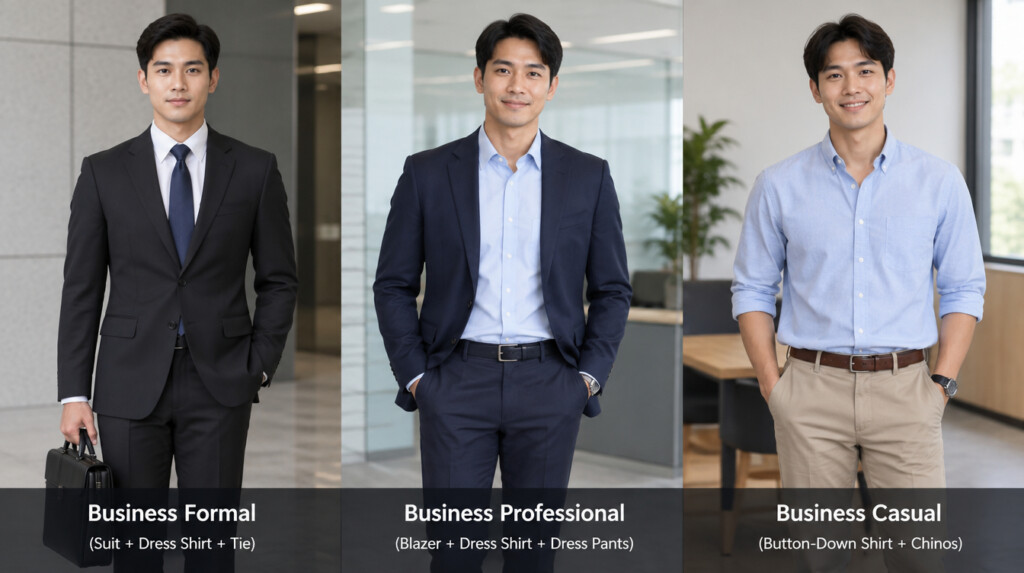
Running from most to least formal: business formal, business professional, business casual.
The distinction between the first two is genuinely blurry and many organisations use them interchangeably. The gap between business professional and business casual is much clearer, because it is the point at which the matched suit disappears.
2. Business Formal
The strictest everyday business dress code, and the one used for board meetings, client presentations, court appearances and formal industry events.
Suit, Shirt and Tie Requirements
A matched suit, meaning the jacket and trousers are cut from the same cloth. Separates do not meet this code, however well they coordinate.
A dress shirt, long sleeved, in a plain or very subtle pattern. White and light blue are the reliable choices.
A tie is expected. Conservative in pattern, silk or a similar formal fabric.
Leather dress shoes, polished, matched to the belt. Oxfords are the most formal option, derbies acceptable in most settings.
Acceptable Colours and Patterns
Navy and charcoal are the two dependable choices. Mid-grey works in most settings.
Black is more formal than business formal, which sounds contradictory but is accurate. Black suits read as evening or ceremonial wear and can look out of place in a daytime business context.
Patterns should be subtle. A fine pinstripe or a muted check is fine. Anything visible across a room is not.
3. Business Professional
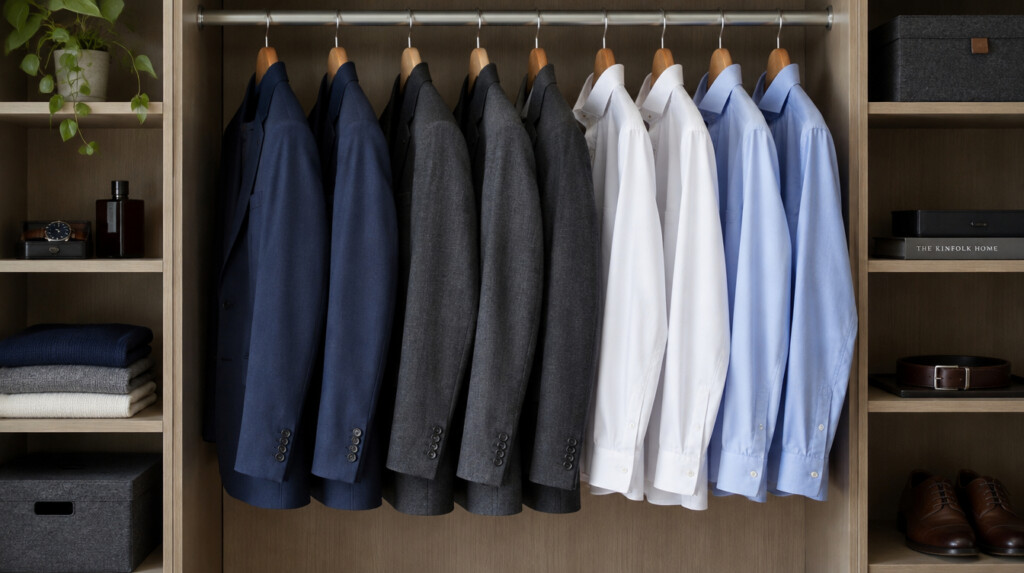
A small step down, and the most common code in professional offices.
Still a suit in most interpretations, but with more room on colour and pattern. A mid-grey check, a subtle windowpane, or a lighter shade of blue all work here where they might be marginal under business formal.
Ties are usual but increasingly optional depending on the industry. Finance and law lean traditional. Technology and creative sectors don’t. Still, follow your company’s rules if they say dress code clearly.
4. Business Casual
The suit comes off. Tailoring stays.
A blazer or sports jacket with separate trousers, or well-cut trousers with a shirt and no jacket. Chinos are usually acceptable. Jeans depend entirely on the workplace.
The common failure here is going too casual and reading as underdressed, or wearing a suit jacket as a blazer, which rarely works because suit jackets are cut to match their trousers and look orphaned without them.
5. Comparison Table: What Each Level Requires
| Business formal | Business professional | Business casual | |
|---|---|---|---|
| Suit | Matched, required | Matched, usually | Not required |
| Colour | Navy, charcoal | Wider range | Open |
| Pattern | Subtle only | Moderate | Open |
| Tie | Expected | Usual, sometimes optional | Rarely |
| Shirt | Plain, formal | Plain or patterned | Open |
| Shoes | Leather dress shoes | Leather dress shoes | Smart, wider range |
6. Reading a Dress Code You Are Unsure About
Ask. It is not embarrassing and it is far less awkward than arriving wrong.
If asking is not possible, look at what the organisation publishes. Photographs from previous events, team pages, and press images will tell you more than the written code.
When genuinely stuck, dress one level up. Being slightly overdressed reads as respectful. Being underdressed reads as careless, and you cannot add a tie you did not bring.
7. Regional and Industry Differences
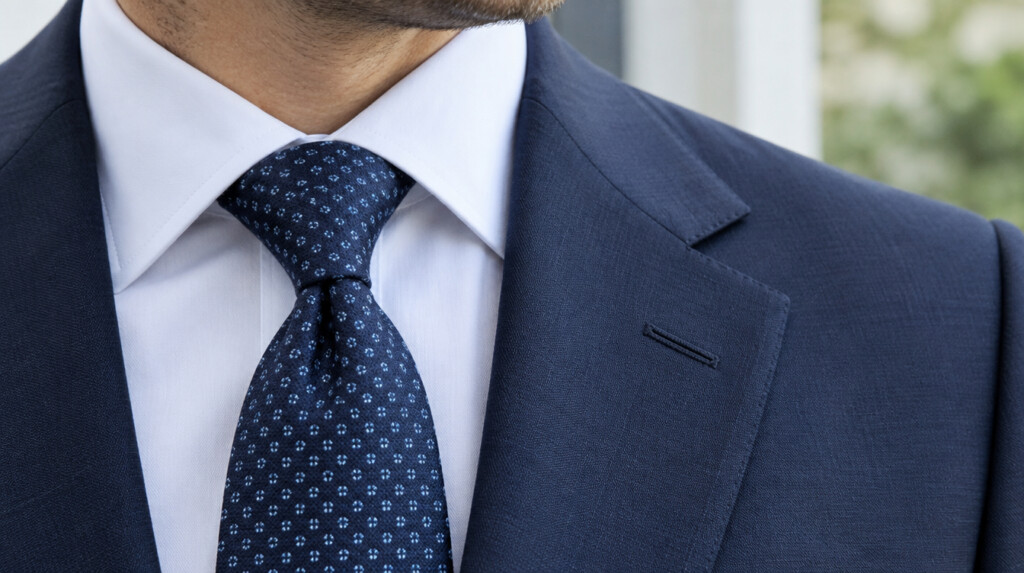
The same phrase means different things in different places. Business formal in London or New York finance is stricter than business formal in many other cities and sectors.
Climate matters too. In hot regions, business formal frequently means a lighter-weight suit and a greater tolerance for removing the jacket indoors. The code adapts to conditions, and pretending otherwise leads to people being uncomfortable for no benefit.
Industry matters most of all. Law, finance, government and consulting sit at the traditional end. Technology, media and creative industries sit far from it, and applying a finance-sector reading of business formal in a startup would look as out of place as the reverse.
Frequently asked questions
What does business formal mean?
A matched suit in a conservative colour, worn with a dress shirt and tie.
What is the difference between business formal and business professional?
The terms overlap heavily, though business formal is generally the stricter of the two on colour and pattern.
Is a blazer acceptable for business formal?
Usually not. Business formal expects a matched suit rather than separates.
Do all business formal settings require a tie?
Most traditionally do, though expectations have relaxed in many industries.